DMRT vs Dunnett’s Test: Differences, Examples & When to Use Each Test
DMRT vs. Dunnett’s Test: Differences, Formulas, Examples, and When to Use Each Test
When researchers perform an analysis of variance (ANOVA), they often need to determine which groups differ significantly from one another. ANOVA can indicate whether statistically significant differences exist among group means, but it does not automatically identify where those differences occur.
This is where post-hoc multiple comparison procedures become important.
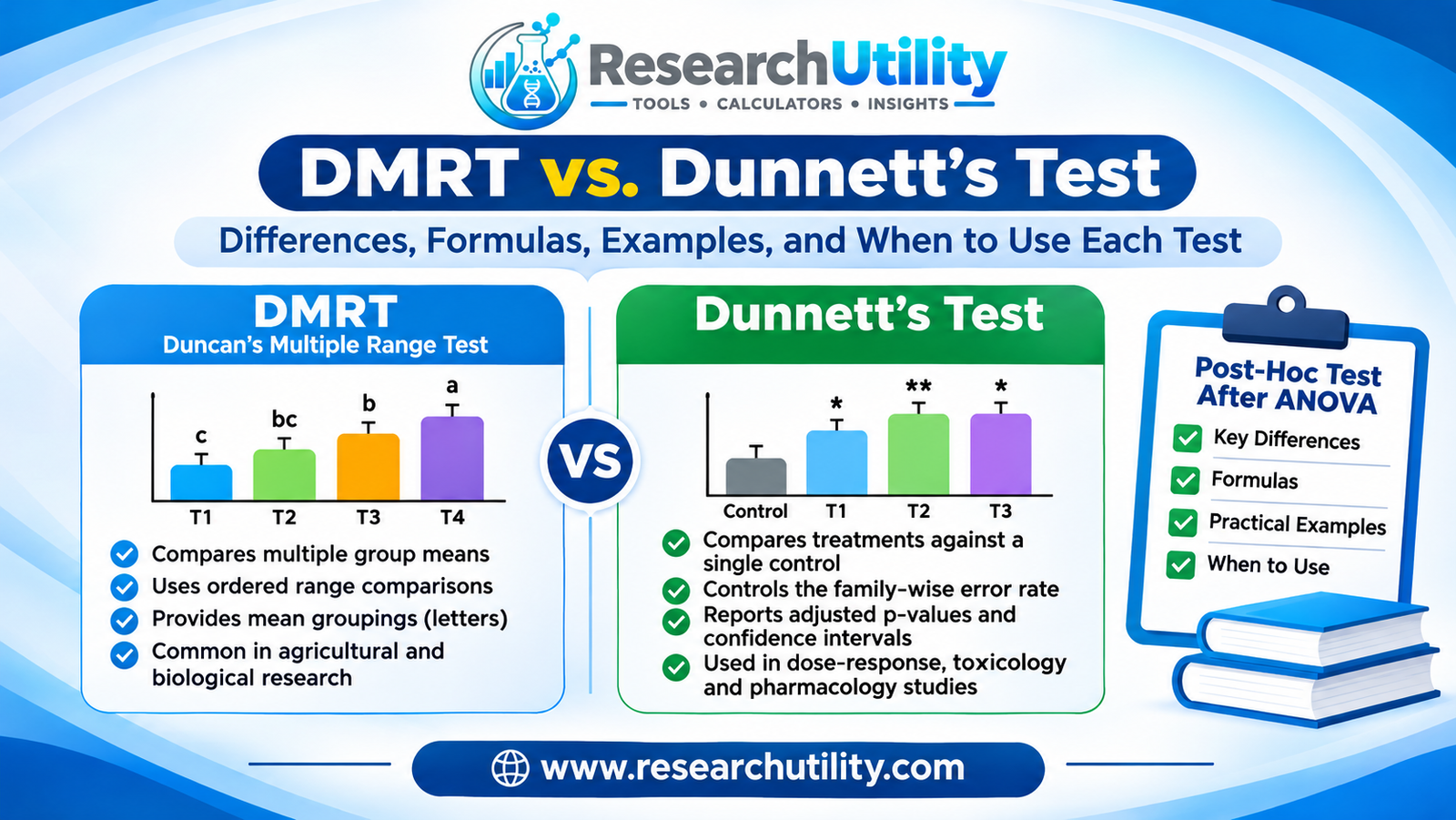
Two statistical procedures commonly used in experimental research are Duncan’s Multiple Range Test (DMRT) and Dunnett’s Test. Both help researchers compare treatment means, but they are designed for different research questions.
DMRT is generally used to compare multiple group means with one another, whereas Dunnett’s Test is specifically designed to compare several treatment groups against a single control group.
Understanding the differences between these methods helps researchers select an appropriate statistical procedure, interpret their results correctly, and report findings with greater confidence.
In this guide, we explain DMRT and Dunnett’s Test, their formulas, assumptions, worked examples, key differences, and how to choose the appropriate test for your research.
Table of Contents
- What Is a Post-Hoc Test?
- What Is Duncan’s Multiple Range Test (DMRT)?
- What Is Dunnett’s Test?
- DMRT vs. Dunnett’s Test: Key Differences
- Statistical Formulas
- Practical Examples
- When Should You Use DMRT?
- When Should You Use Dunnett’s Test?
- Assumptions and Limitations
- How to Perform DMRT and Dunnett’s Test
- How to Report Results in Research
- Frequently Asked Questions
1. What Is a Post-Hoc Test?
A post-hoc test is a statistical procedure used to identify which specific group means differ after comparing several groups.
In a one-way ANOVA, the null hypothesis is that all population group means are equal:
H₀: μ₁ = μ₂ = μ₃ = … = μₖ
The alternative hypothesis is that at least one population mean differs.
A statistically significant ANOVA result indicates evidence of a difference somewhere among the groups. However, it does not identify the particular groups responsible for that difference.
Post-hoc procedures help investigate these differences while accounting, to varying degrees, for the multiple comparisons being conducted.
Common multiple comparison procedures include:
- Duncan’s Multiple Range Test (DMRT)
- Dunnett’s Test
- Tukey’s Honestly Significant Difference (HSD)
- Bonferroni correction
- Scheffé’s Test
- Holm’s procedure
The choice of procedure should depend on the research objective, comparison structure, and acceptable Type I error rate.
2. What Is Duncan’s Multiple Range Test (DMRT)?
Duncan’s Multiple Range Test (DMRT), also known as Duncan’s New Multiple Range Test, is a multiple comparison procedure used to compare several treatment means following an analysis of variance.
It is frequently used in agricultural experiments, biological research, laboratory studies, and other experimental designs involving multiple treatments.
DMRT arranges sample means in ascending or descending order and evaluates differences between means using a range-based critical value.
Unlike procedures that use one common critical difference for every comparison, DMRT uses critical ranges that depend on the number of ordered means spanned by a comparison.
How does DMRT work?
The general procedure involves:
- Perform an appropriate ANOVA.
- Examine the ANOVA result.
- Arrange treatment means in ascending or descending order.
- Calculate the standard error of the mean difference using the pooled error variance.
- Determine the appropriate studentized-range critical value for each range size.
- Compare observed differences with the corresponding critical ranges.
- Assign grouping letters to indicate statistically distinguishable means.
Means sharing at least one letter are not identified as significantly different under the selected DMRT procedure. Means with no letter in common are identified as significantly different.
Example of DMRT grouping
| Treatment | Mean | DMRT group |
|---|---|---|
| Treatment C | 24.0 | a |
| Treatment B | 19.0 | b |
| Control | 14.0 | c |
In this example:
- Treatment C has the highest mean.
- Treatment B has an intermediate mean.
- Control has the lowest mean.
- The different letters indicate statistically distinguishable groups under the applied procedure.
Important: Letter groupings should always be interpreted using the specified significance level and the actual multiple comparison results. They do not represent effect sizes or biological importance.
Try the DMRT Calculator
Use the ResearchUtility Duncan’s Multiple Range Test Calculator to compare treatment means using experimental data.
Tool: DMRT Calculator
The calculator supports manual data entry and CSV-based analysis, with downloadable results.
3. What Is Dunnett’s Test?
Dunnett’s Test is a multiple comparison procedure developed to compare several treatment groups against one common control group.
It is particularly useful in experiments where researchers want to determine whether different treatments produce statistically significant effects compared with an untreated, standard, or reference control.
For example, a toxicological experiment might investigate whether three different chemical concentrations produce effects compared with a control group.
Rather than comparing every treatment against every other treatment, Dunnett’s Test focuses on treatment-versus-control comparisons.
How does Dunnett’s Test work?
The general procedure involves:
- Identify the control group.
- Calculate the treatment and control group means.
- Estimate the pooled error variance from the experimental model.
- Calculate each treatment-versus-control test statistic.
- Account for the correlation among comparisons that share the same control.
- Obtain Dunnett-adjusted p-values or simultaneous confidence intervals.
- Interpret each treatment comparison against the control.
The method controls the family-wise Type I error rate across the set of treatment-versus-control comparisons under its specified assumptions.
Example of Dunnett’s Test comparisons
Suppose a researcher investigates the effects of three treatments against a control group.
| Group | Mean | Comparison |
|---|---|---|
| Control | 10.0 | Reference |
| Treatment A | 13.0 | A vs. Control |
| Treatment B | 16.0 | B vs. Control |
| Treatment C | 12.0 | C vs. Control |
Dunnett’s Test evaluates:
- Treatment A versus Control
- Treatment B versus Control
- Treatment C versus Control
It does not primarily test Treatment A versus Treatment B or Treatment B versus Treatment C.
The statistical results determine which treatment groups differ significantly from the control.
Try the Dunnett’s Test Calculator
Use the ResearchUtility Dunnett’s Test Calculator to compare multiple treatment groups against a selected control.
Tool: Dunnett’s Test
The calculator supports manual data entry, CSV upload, selectable control groups, adjusted p-values, and simultaneous confidence intervals.
4. DMRT vs. Dunnett’s Test: Key Differences
Although both methods are used for multiple comparisons, their purposes are different.
| Feature | DMRT | Dunnett’s Test |
|---|---|---|
| Full name | Duncan’s Multiple Range Test | Dunnett’s Test |
| Main purpose | Compare multiple group means | Compare treatments against a control |
| Comparison structure | Multiple ordered mean comparisons | Treatment-versus-control comparisons |
| Control group required | No | Yes |
| Common application | Agricultural and biological experiments | Toxicology, pharmacology, and treatment studies |
| Error-rate approach | Stepwise range procedure; relatively liberal | Controls family-wise error across treatment-control comparisons |
| Statistical basis | Studentized-range critical ranges | Joint distribution of correlated test statistics |
| Interpretation | Mean differences and grouping letters | Adjusted p-values and simultaneous confidence intervals |
Which test is more appropriate?
The correct procedure depends on the scientific question.
Choose DMRT when your objective is to compare several treatment means and identify differences among the groups.
Choose Dunnett’s Test when your objective is to determine which treatments differ from a single control group.
One important distinction is that DMRT is generally more liberal than several commonly used multiple comparison procedures. This can increase the chance of identifying differences, but it may also increase the risk of false-positive findings.
Dunnett’s Test is specifically designed to control the family-wise error rate for its treatment-versus-control comparisons.
5. Statistical Formulas
Understanding the underlying statistical calculations helps researchers interpret the results rather than relying only on calculator outputs.
5.1 DMRT formula
A general range-based comparison can be expressed as:
Rₚ = qₚ × SE
Where:
- Rₚ = critical range for a comparison spanning p ordered means
- qₚ = appropriate studentized-range critical value for that range size
- SE = standard error used in the DMRT procedure
For a balanced one-way ANOVA design, the standard error is commonly expressed as:
SE = √(MSE / n)
Where:
- MSE = mean square error from ANOVA
- n = number of observations per group
For unequal sample sizes, the standard error calculation must account for the relevant group sample sizes and the selected implementation.
An observed difference is evaluated against the corresponding critical range.
5.2 Dunnett’s Test formula
For a treatment group compared with a control group, the test statistic is generally expressed as:
tᵢ = (X̄ᵢ − X̄c) / SEᵢc
Where:
- X̄ᵢ = mean of treatment group i
- X̄c = mean of the control group
- SEᵢc = standard error of the treatment-control difference
For a one-way ANOVA model with pooled error variance:
SEᵢc = √[MSE × (1/nᵢ + 1/nc)]
Where:
- MSE = pooled mean square error
- nᵢ = treatment group sample size
- nc = control group sample size
The calculated test statistics are evaluated using a critical value or adjusted probability based on the joint distribution of the correlated treatment-control comparisons.
This correlation matters because all treatment groups share the same control group.
Why are the formulas different?
DMRT uses ordered ranges of means to evaluate multiple differences across the groups.
Dunnett’s Test uses treatment-control contrasts and accounts for the dependence among comparisons sharing a common control.
Therefore, the two procedures should not be treated as interchangeable.
6. Practical Examples
Example A: Using DMRT in an agricultural experiment
A researcher investigates the effect of four fertilizer treatments on plant growth.
The groups are:
- Control
- Fertilizer A
- Fertilizer B
- Fertilizer C
The research objective is to identify differences among all treatment means.
DMRT may be appropriate when the researcher wants to compare the treatment means and organize them into statistically distinguishable groups.
For example, the results might be presented as:
| Treatment | Mean plant height | Group |
|---|---|---|
| Fertilizer C | 28.5 | a |
| Fertilizer B | 25.2 | b |
| Fertilizer A | 21.7 | c |
| Control | 18.4 | d |
The grouping indicates the results of the selected DMRT procedure at the specified significance level.
Example B: Using Dunnett’s Test in a toxicological experiment
A researcher investigates the effects of three concentrations of a chemical compound on an experimental organism.
The groups are:
- Control
- Low concentration
- Medium concentration
- High concentration
The objective is to determine whether each concentration produces a significant effect compared with the control.
Dunnett’s Test is suitable for this comparison structure.
The results could be summarized as:
| Comparison | Mean difference | Adjusted p-value | Interpretation |
|---|---|---|---|
| Low vs. Control | 2.1 | 0.18 | Not significant |
| Medium vs. Control | 5.4 | 0.02 | Significant |
| High vs. Control | 8.2 | 0.001 | Significant |
These values are illustrative only, not calculated experimental results.
In this example, the medium and high concentrations differ significantly from the control after adjustment for the multiple comparisons.
7. When Should You Use DMRT?
DMRT may be considered when:
- You need to compare several treatment means.
- Your research involves multiple experimental groups.
- You want to identify statistically distinguishable mean groupings.
- Your field or study protocol specifies Duncan’s procedure.
- You understand its relatively liberal multiple comparison characteristics.
It is commonly encountered in agricultural, biological, and experimental research.
However, researchers should consider whether a more conservative procedure, such as Tukey’s HSD, is more appropriate for all-pairwise comparisons.
8. When Should You Use Dunnett’s Test?
Dunnett’s Test is appropriate when:
- Your experiment includes one common control group.
- You want to compare several treatments against that control.
- You do not need every treatment-to-treatment comparison.
- You want family-wise error control for the treatment-control comparisons.
- Your research involves dose-response, toxicological, pharmacological, or intervention experiments.
For example, if a study investigates the effects of five doses of a compound against an untreated control, Dunnett’s Test can address the central research question directly.
9. Assumptions and Limitations
Both procedures rely on assumptions related to the statistical model and experimental design.
Common assumptions
- Independence: Observations should be independent according to the experimental design.
- Normality: Model residuals should be reasonably consistent with the normality assumption, particularly for small samples.
- Variance homogeneity: The conventional pooled-variance procedures assume equal population variances across groups.
- Appropriate experimental design: The selected statistical model must reflect how the data were collected.
Limitations of DMRT
- It is relatively liberal compared with many other multiple comparison methods.
- It may produce more significant findings and a higher risk of false positives.
- Results should be interpreted in light of the study’s significance level and comparison strategy.
Limitations of Dunnett’s Test
- It is designed for comparisons against a common control, not all possible pairwise comparisons.
- Conventional versions rely on an appropriate common error variance.
- Its results depend on the selected model, significance level, and one-sided or two-sided testing direction.
If equal variance or independence assumptions are seriously violated, researchers should investigate alternative models or procedures appropriate to their data.
10. How to Perform DMRT and Dunnett’s Test
Researchers can use statistical software or validated calculators to perform multiple comparison analyses.
Performing DMRT with ResearchUtility
- Open the Duncan’s Multiple Range Test Calculator.
- Enter the treatment groups and their observations.
- Alternatively, upload a supported CSV file.
- Check the imported group names and observations.
- Select the significance level and available analysis settings.
- Run the calculation.
- Review the ANOVA summary and DMRT mean comparisons.
- Download the results for further examination.
Open the tool: https://researchutility.com/duncan-multiple-range-test-calculator/
Performing Dunnett’s Test with ResearchUtility
- Open the Dunnett’s Test Calculator.
- Enter the control group and treatment observations.
- Alternatively, upload a supported CSV file.
- Select the correct control group.
- Choose the significance level and simulation settings available in the calculator.
- Run the analysis.
- Examine the treatment-versus-control comparisons.
- Review adjusted p-values and simultaneous confidence intervals.
- Download the results.
Open the tool: https://researchutility.com/dunnetts-test-calculator/
Statistical verification note: Calculator implementations should be checked against established statistical software using representative datasets before their outputs are used in scientific publications. In particular, the ResearchUtility Dunnett implementation uses Monte Carlo simulation to estimate the correlated multivariate-t distribution, so its adjusted p-values and confidence limits are simulation-based estimates rather than exact tabulated values. For publication-quality analysis, verify the results using validated software and document the method used.
11. How to Report Results in Research
Clear statistical reporting is essential for scientific transparency and reproducibility.
Example of DMRT reporting
“The experimental data were analyzed using one-way analysis of variance (ANOVA), followed by Duncan’s Multiple Range Test to identify differences among treatment means. Differences were considered statistically significant at p < 0.05. Results are presented as mean values with the appropriate measure of variability. Means sharing the same letter were not significantly different according to the applied DMRT procedure.”
Example of Dunnett’s Test reporting
“Treatment groups were compared with the control group using Dunnett’s multiple comparison procedure following the specified statistical model. Adjusted p-values were used to evaluate treatment-control differences while controlling the family-wise Type I error rate at the selected significance level.”
For a complete report, also specify:
- The statistical software and version.
- The significance level.
- Whether comparisons were one-sided or two-sided, where relevant.
- The model and variance assumptions.
- The sample size for each group.
- The adjustment or simulation method used, if applicable.
Avoid reporting only whether a result was significant. Include the relevant test statistics, degrees of freedom, adjusted p-values, confidence intervals, and effect estimates where available.
12. Frequently Asked Questions
1. What is the main difference between DMRT and Dunnett’s Test?
DMRT compares multiple group means using an ordered range procedure, whereas Dunnett’s Test compares multiple treatment groups against a single common control group.
2. Is DMRT a post-hoc test?
Yes. Duncan’s Multiple Range Test is commonly used as a post-ANOVA multiple comparison procedure to examine differences among group means.
3. Is Dunnett’s Test better than DMRT?
Neither procedure is universally better. Dunnett’s Test is more appropriate for treatment-versus-control comparisons, while DMRT addresses comparisons among multiple means. The research objective should determine the choice.
4. Can Dunnett’s Test compare all treatment groups with each other?
No. Its standard purpose is to compare each treatment with a common control. Use an appropriate all-pairwise procedure, such as Tukey’s HSD, when comparisons among all treatment groups are required.
5. Can DMRT be used after one-way ANOVA?
Yes. DMRT is commonly used following one-way ANOVA when researchers need to investigate differences among multiple group means.
6. Does Dunnett’s Test control Type I error?
Yes. Dunnett’s Test is designed to control the family-wise Type I error rate across the specified treatment-versus-control comparisons under the assumptions of the procedure.
7. What is the difference between Tukey’s HSD and Dunnett’s Test?
Tukey’s HSD is designed for all pairwise comparisons among group means, whereas Dunnett’s Test focuses on comparisons between treatments and a common control.
8. Can DMRT and Dunnett’s Test be used for biological experiments?
Yes. Both procedures can be useful in biological research, depending on the experimental design and the scientific question. DMRT is useful for comparing several treatment means, while Dunnett’s Test is useful when treatments are evaluated against a control.
9. Which test should I use when I have one control and several treatment groups?
Dunnett’s Test is generally the more direct choice when your primary objective is to compare each treatment against the control.
10. Can I use these tests with unequal sample sizes?
Both procedures have implementations that can accommodate unequal sample sizes, but the standard errors and critical-value calculations must correctly account for the group sizes. Confirm that the software or calculator supports your particular design.
Conclusion
DMRT and Dunnett’s Test are useful statistical procedures for answering different types of experimental research questions.
DMRT helps researchers compare multiple treatment means and identify statistically distinguishable groups. Dunnett’s Test focuses on determining whether individual treatment groups differ significantly from a common control.
The most important consideration is not which test is more powerful or popular, but which procedure matches the comparison structure and scientific objective of the experiment.
Before publishing results, researchers should verify statistical assumptions, use an appropriate multiple comparison procedure, and cross-check calculator outputs with established statistical software.
Explore the free statistical calculators at ResearchUtility:
ResearchUtility provides practical research tools to help students, scholars, and scientists perform statistical analyses and understand their experimental data.
Make your statistical analysis more accurate, transparent, and research-oriented with ResearchUtility.