
ResearchUtility: Free Research Tools, Scientific & Statistical Calculators
ResearchUtility: Free Research Tools, Scientific & Statistical Calculators
Description
Research often involves much more than collecting data and writing a research paper. Researchers and students regularly need to perform statistical calculations, prepare laboratory solutions, convert scientific units, analyze data, calculate sample sizes, search academic literature, and check mathematical results.
Using different websites or software programs for every small task can make the research workflow unnecessarily complicated.
ResearchUtility is designed to make these everyday research tasks easier by bringing practical research tools and scientific calculators together in one online platform.
Whether you are a PhD scholar, undergraduate student, laboratory researcher, scientist, teacher, or academic professional, ResearchUtility provides a growing collection of online tools designed to support different stages of the research process.
What Is ResearchUtility?
ResearchUtility is an online research resource platform that provides practical calculators, scientific utilities, statistical tools, laboratory tools, and literature research resources.
The idea behind the platform is simple: researchers frequently need small calculations and utilities while working on experiments, analyzing data, preparing solutions, reviewing literature, or writing research reports.
Instead of searching for a separate tool every time, ResearchUtility aims to provide these resources in one organized platform.
The website brings together several categories of tools, including:
- Statistical calculators
- Research and data tools
- Laboratory and solution calculators
- Scientific utilities
- Literature research resources
- Scientific and mathematical calculators
This makes the platform useful across multiple stages of an academic or scientific research workflow.
Why Are Online Research Tools Useful?
Research calculations can sometimes be repetitive, especially when working with experimental data or laboratory measurements.
For example, a researcher may need to calculate:
- Mean
- Standard deviation
- Standard error
- Variance
- Percentage change
- Correlation
- Regression
- Confidence intervals
- Sample size
- Molarity
- Dilution
- Normality
- Molecular weight
- Scientific notation
- Significant figures
These calculations are important, but researchers may not want to manually perform every calculation using a calculator or spreadsheet.
Online research calculators can provide a convenient way to perform these routine calculations.
However, calculators should be considered supporting tools, not replacements for understanding the underlying statistical or scientific concepts.
Statistical Tools for Research Data Analysis
Statistical analysis is an essential part of many scientific studies.
Researchers use statistics to summarize observations, compare groups, investigate relationships between variables, and evaluate hypotheses.
ResearchUtility includes a dedicated collection of statistical calculators designed around common research calculations.
Depending on the tool available, researchers can work with calculations involving concepts such as:
Mean
The arithmetic mean is one of the most commonly used measures of central tendency.
It provides an average value for a dataset and is frequently used when summarizing experimental observations.
Median
The median represents the middle value of an ordered dataset and can be particularly useful when data contain extreme values or are not symmetrically distributed.
Standard Deviation
Standard deviation provides information about the variability or dispersion of observations around the mean.
Standard Error
Standard error is commonly used when describing the uncertainty associated with an estimated sample mean.
Variance
Variance provides another measure of data variability and forms an important part of many statistical analyses.
Correlation
Correlation analysis can help researchers examine the strength and direction of relationships between variables.
Regression
Regression analysis is widely used to investigate relationships between dependent and independent variables and to develop predictive models.
T-Test and ANOVA
Hypothesis-testing procedures such as t-tests and analysis of variance (ANOVA) are frequently used in experimental research to compare groups.
ResearchUtility brings these types of calculations into an accessible online environment so researchers can perform routine calculations more conveniently.
Research & Data Tools
Statistical analysis is only one part of research data preparation.
Researchers also need tools for planning experiments and handling research data.
ResearchUtility’s Research & Data Tools section includes practical utilities such as:
- Sample Size Calculator
- Confidence Interval Calculator
- Random Number Generator
- Percentage Calculator
- Scientific Calculator
- Confidence Level Calculator
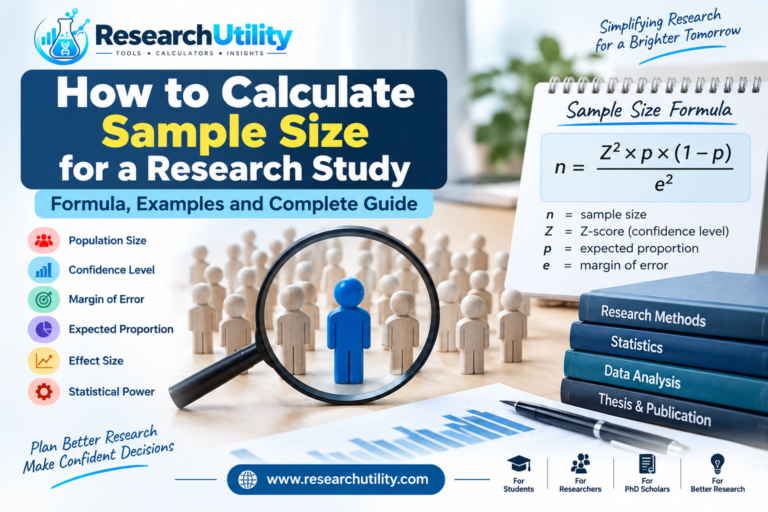
Sample Size Calculator
Choosing an appropriate sample size is an important part of research design.
A sample that is too small may provide insufficient information, while an unnecessarily large sample may require additional time and resources.
A sample size calculator can help researchers perform the mathematical part of sample-size estimation, although the appropriate assumptions and study design should always be determined carefully.
Confidence Interval Calculator
Confidence intervals are commonly used to express uncertainty around estimated parameters.
A confidence interval calculator can help researchers perform the relevant mathematical calculations more efficiently.
Random Number Generator
Random numbers can be useful in research for:
- Sampling
- Experimental allocation
- Randomization
- Simulations
- Research design
A dedicated random number generator can therefore be a useful small utility during research planning.
Laboratory & Solution Calculators
Laboratory research often requires precise calculations.
Preparing solutions, converting concentrations, determining dilution volumes, and calculating molecular weights are routine tasks in many laboratories.
ResearchUtility includes a dedicated Laboratory & Solution Tools section.
Some of the available tools include:
- Molarity Calculator
- Dilution Calculator
- Normality Calculator
- Concentration Calculator
- Solution Preparation Calculator
- pH Calculator
Molarity Calculator
Molarity expresses the amount of solute in moles per unit volume of solution.
Researchers frequently use molarity when preparing chemical solutions for laboratory experiments.
A molarity calculator can make these calculations faster and reduce repetitive manual arithmetic.
Dilution Calculator
Dilution calculations are common when preparing working solutions from concentrated stock solutions.
The familiar relationship:
C₁V₁ = C₂V₂
is widely used for dilution calculations when its assumptions are applicable.
A dilution calculator can simplify the calculation of the required volume of stock solution and final solution volume.
Normality Calculator
Normality is another concentration expression used in certain chemical and analytical applications.
A normality calculator can help perform the corresponding calculations based on the relevant chemical equivalent relationship.
Concentration Calculator
Concentration calculations are fundamental in laboratory research.
Depending on the type of measurement, researchers may work with different concentration units and relationships.
An online concentration calculator can provide a convenient way to perform routine calculations.
Scientific Utilities for Everyday Research
Scientific research involves many unit conversions and numerical calculations that may not fall into conventional statistical analysis.
ResearchUtility’s Scientific Utilities section addresses some of these everyday requirements.
Available tools include:
- Unit Converter
- Temperature Converter
- Molecular Weight Calculator
- Time Converter
- Scientific Notation Calculator
- Significant Figures Calculator
Unit Converter
Researchers often work with different measurement systems.
A unit converter can help convert between commonly used scientific and laboratory units.
Temperature Converter
Temperature conversion is frequently required in laboratory and scientific work.
The temperature converter can be useful for converting between:
- Celsius
- Fahrenheit
- Kelvin
Molecular Weight Calculator
Chemical formulas can be used to determine molecular or formula mass.
A molecular weight calculator can simplify the arithmetic involved in calculating the total molecular mass from the constituent elements.
Scientific Notation Calculator
Scientific notation is particularly useful when dealing with very large or very small values.
It is commonly encountered in:
- Molecular biology
- Chemistry
- Physics
- Environmental science
- Biotechnology
- Biomedical research
Significant Figures Calculator
Scientific measurements require appropriate treatment of precision.
Significant figures help communicate the meaningful precision of a measured or calculated value.
A significant figures calculator can assist researchers and students when performing calculations involving measured quantities.
Literature Research Tools
Finding relevant scientific literature is one of the first steps in many research projects.
Before designing an experiment or writing a literature review, researchers need to identify previous studies, understand existing knowledge, locate research gaps, and examine relevant publications.
ResearchUtility also provides a Literature Tools section that brings together useful academic search and discovery resources.
Examples include resources such as:
- Google Scholar
- Semantic Scholar
- PubMed
- Crossref
- Other literature discovery resources
These platforms can help researchers search for scientific papers, theses, books, citations, DOI information, biomedical literature, and other academic resources.
ResearchUtility for PhD Students
PhD researchers often work across several different stages simultaneously.
A doctoral researcher may need to:
- Search scientific literature.
- Identify research gaps.
- Design experiments.
- Calculate sample sizes.
- Prepare laboratory solutions.
- Record experimental observations.
- Analyze datasets.
- Perform statistical tests.
- Interpret results.
- Prepare tables and figures.
- Write manuscripts and thesis chapters.
ResearchUtility can serve as a convenient collection of small tools throughout this workflow.
For example, a researcher may move from a literature search to sample-size planning, then to laboratory calculations, followed by statistical analysis.
Having frequently used tools organized in one platform can save time during these repetitive tasks.
ResearchUtility for Students
ResearchUtility is not limited to PhD researchers.
Students working on:
- Laboratory practicals
- Dissertation projects
- Undergraduate research
- Master’s projects
- Scientific assignments
- Data analysis exercises
- Academic presentations
may also find these tools useful.
For students, online calculators can be particularly helpful when learning how scientific formulas work.
The best approach is to understand the formula first and then use a calculator to verify the calculation.
ResearchUtility for Scientists and Laboratory Researchers
Laboratory researchers frequently perform calculations involving concentrations, volumes, temperatures, units, molecular weights, and solution preparation.
Even when researchers are comfortable performing these calculations manually, having an online tool available can provide a quick verification step.
For example, before preparing a solution, a researcher can independently check the calculated amount of compound required.
This can help reduce avoidable arithmetic errors, although laboratory calculations should always be independently verified before experimental use.
One Platform for Different Research Tasks
One of the major advantages of organizing research tools into categories is that researchers can find the appropriate tool more quickly.
Instead of treating every calculator as a separate resource, ResearchUtility organizes tools according to their practical purpose.
Literature Research
Discover → Search → Review → Identify research gaps
Laboratory Work
Calculate → Prepare → Measure → Experiment
Data Analysis
Organize → Calculate → Analyze → Interpret
Scientific Work
Convert → Calculate → Verify → Apply
This makes ResearchUtility more than simply a collection of calculators. It is intended to become a practical research utility platform.
Are Online Research Calculators Reliable?
An important question is whether researchers should trust online calculators.
The answer is: use them as calculation aids, not as unquestionable authorities.
Researchers should always:
- Understand the formula being used.
- Check the units.
- Verify input values.
- Check assumptions.
- Confirm the output.
- Use appropriate statistical methods.
- Consult authoritative references when necessary.
For important research decisions, statistical conclusions, laboratory preparations, or publication-quality analysis, results should be independently verified.
ResearchUtility is designed to make calculations more convenient, but scientific judgment remains the responsibility of the researcher.
What Makes ResearchUtility Different?
ResearchUtility focuses on a simple idea:
Instead of focusing on a single type of calculation, the platform brings together different categories of research resources.
Its growing ecosystem includes:
📊 Statistical Tools
For statistical calculations and data analysis.
🧪 Research Tools
For laboratory, solution, scientific, and research calculations.
📚 Literature Tools
For academic literature discovery and research resources.
🔬 Scientific Utilities
For scientific conversions and numerical calculations.
This combination makes the platform useful at different stages of the research process.
The Future of ResearchUtility
ResearchUtility is being developed as a growing platform rather than a static collection of calculators.
As more tools are added, the platform can become increasingly useful for researchers, students, scientists, and academics.
Future research utilities could cover additional areas such as:
- Advanced statistical analysis
- Experimental design
- Data visualization
- Biological calculations
- Chemistry calculations
- Epidemiological calculations
- Research writing utilities
- Citation and reference tools
- Scientific unit conversions
- Additional laboratory calculators
The goal is to continue building practical online resources that address common research problems.
Start Using ResearchUtility
Research does not have to become complicated because of small calculations.
Whether you are searching for scientific literature, preparing a laboratory solution, checking a statistical calculation, converting scientific units, or working with research data, having the right utility at the right time can make the workflow more efficient.
ResearchUtility brings these practical resources together in one place for researchers, students, scientists, and academics.
Explore the available tools, choose the category relevant to your work, and use the calculators as practical aids alongside your scientific knowledge and research methodology.
Start exploring ResearchUtility today and simplify the small calculations that are part of your bigger research journey.
ResearchUtility — Tools, Calculators & Insights for Researchers.